Le Petit Moras and silk
When we bought Le Petit Moras, we knew nothing about silk farming. That's not really an option when you become the owner of a former silkworm farm!
I read up on the rich history of silk farming in the Ardèche. And the wonderful thing is: that world really came to life for me. It's as if the stories still linger within the thick walls... I'd like to take you back in time.
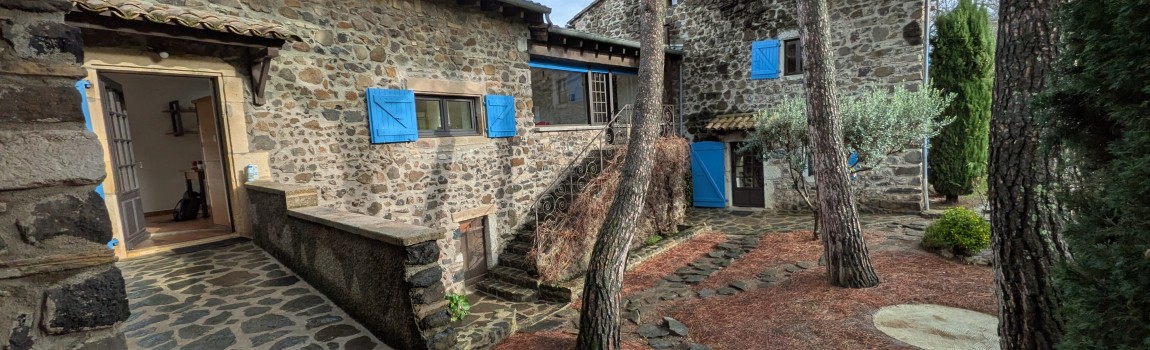
Stand in front of the left wing of the farmhouse and close your eyes for a moment. Imagine a light, well-ventilated room on the upper floor. Along the walls are wooden racks with flat frames or mats on which the silkworms lie. These larvae of the silkworm moth are real gluttons: they are fed several times a day with fresh, juicy leaves from the mulberry tree.
The temperature and hygiene in the nursery are crucial: everything is kept meticulously clean to prevent disease. After a few weeks, the caterpillars begin to spin their cocoons. These cocoons are harvested and sold to filatures de soie: silk weaving mills. This is intensive work, which would also have been done by the whole family on our farm.
The first filature in the region was built in Chomérac. That must have been shortly after 1752. In that year, a certain Henri Deyzier was commissioned by Inspector Vaucanson, a high-ranking official at the court of Louis XV, to build the Manufacture Royale de la Soie. After that, things moved quickly. At one point, there were at least seven silk factories in Chomérac.
Silk cultivation thus became an important source of income in the Ardèche. That changed when diseases broke out in the mid-nineteenth century. The silkworms died en masse, causing great hardship for the breeders. Artificial silk and cheaper raw silk from Italy and Asia then dealt the final blow to the silk industry.
Unfortunately, I have not (yet) been able to find out when “our” farm ceased to be a farm.
Do you know how silk is made? I will explain it to you below.
It all starts with the silkworm. It spins a cocoon with the thread that comes from its silk glands. When the butterflies emerge from the cocoon, the males and females seek each other out to mate, after which the male dies.
The female then lays three to five hundred eggs, after which she also dies. The caterpillars that hatch from the eggs eat their fill of mulberry leaves. Once mature, they spin themselves into a cocoon. Then the whole story starts again.
To extract the silk, the cocoon is soaked, after which the silk threads are processed into yarn. This is dyed, dried and spun into strands.
Did you know that silk was discovered in ancient China around 2700 BC, and that it was discovered by accident? The story goes that Empress Leizu, the wife of the Yellow Emperor, was sitting under a mulberry tree drinking tea when a cocoon fell into her cup. She was amazed to see beautiful shiny threads unravelling in the warm liquid. It was a eureka moment for the Empress: what if she collected those cocoons and had the threads made into fabric for a robe? The rest is history.
A dive into silk cultivation
Would you like to know more about silk production in the Ardèche? Then a visit to the Musée vivant du Ver à Soie in Lagorce is highly recommended. It is literally a living museum: from April to October, it houses several complete colonies of silkworms.
https://lagorceardeche.com/musee-magnanerie
This is our own website with the best price. Click here for our accommodations or ask us your question.